|
Lovebirds ~ The Misunderstood Longfeathered
|
The first Longfeathered was exhibited at the National in Holland in 1990, the first phenotype was in the works approximately 15 years prior, and they came into the United States in 1993. Why are they still so misunderstood and judges still can't even judge a Longfeathered?
I have sat quietly for years listening to the
comments some judges make at the shows about the Longfeathered and I can't help wonder why
they refuse to educate themselves about the Longfeathered even if they dislike the bird.
Surely they never asked anyone or they would sound somewhat educated when they referred to
the Longfeathered at the shows. I am tired of hearing the Longfeathered are a headache and
guess what? With such ignorant attitude I am here to give the judges the biggest Migraine
they ever had!
I have seen very few judges who seem to know what to look for, they make an effort to
learn and do not make ignorant comments when the Longfeathered section is presented.
Whether they like or dislike the Longfeathered they keep that to themselves and judge the
bird accordingly
I heard a judge say right before the Longfeathered section was presented at a National
show, "I don't know anything about the Longfeathered, so let's see what we got"
... and during the judging the judge refers to a bird as being "too big" so he
chooses a Peachfaced with traces of Longfeathered. Once again, at a National Show, the
large Longfeathered is punished for representing a true Longfeathered.
There was no extra credit given to the
Longfeathered for size, in fact, he referred to one of the birds as being too large. The
Longfeathered should not be punished for being large, the overall shape and size of the
Longfeathered looks more like the "Visual Standard" of the Peachfaced than most
of the birds which end up on the top bench.
Another comment was made as to the bird having fluffed feathers, this is a perfect example
of not knowing the bird and it's traits. It does not matter if ALBS does not have any
standards yet for the Longfeathered, know the bird and it's traits, don't punish the bird
because of your lack of knowledge and don't excuse your lack of knowledge because there
are no standards for the Longfeathered. Use common sense and educate yourself so when you
speak about the bird you say the correct things or say nothing at all.
For years I have heard people comment that the Longfeathered looks ill because they are
fluffed, having fluffed feathers is a trait of the Longfeathered and that cannot be
changed unless it is "diluted."
Let's stop being so ignorant and let's learn more about these birds. They are not ill,
they are not supposed to have tight feathers ... they are just different.
Think of those canaries which look like they have Scoliosis and the Frill Canaries with fluffed feathers pointing every where but down, they are not sick, they are different. Let's learn that all the Love Birds are not alike and accept that the Longfeathered is different from a Peachfaced.
The Longfeathered should not be punished for being fluffed, tight feathers is a trait of the Peachfaced and not of the Longfeathered.
The less percentage of Longfeathered a bird has,
the more tight feathers it will have, so why are we punishing the true Longfeathered?
The judges do not understand this because the majority do not own nor breed the
Longfeathered. They are accustomed to judge Love Birds with the tight feathers and they
want the Longfeathered to have the same appearance, but when a bird has double down
feathers, as the Longfeathered has, it will not look as tight as the rest of the species
of Love Birds on the bench.
Let me remind all of you that a section was made for the Longfeathered so they would not
have to be compared within the same section to the Peachfaced, anything with traces of
Longfeathered will be moved to the Longfeathered section.
If a Longfeathered has it's own section and within this section all the Longfeathered are exhibited, why are the Longfeathered being judged and compared to the Peachfaced even in the Longfeathered section? Why are the "diluted" Longfeathered winning over the true Longfeathered? The answer is that the majority of judges do not know what is a fault and what is a normal trait for a Longfeathered ... and the interesting part is that the judges will not ask anyone who breeds the Longfeathered or even bother to learn more about them.
The judge's excuse is that they judge the
Longfeathered to the standard they use to judge a Peachfaced ... but do they do the same
when they judge a Peachfaced, a Nyasa or an Abyssinian against each other in a smaller
show where there is only one Division?
The second comment judges like to make is: "I don't like the Longfeathered" ...
I find this comment very unprofessional. No matter what a judge does not like or
breeds he/she needs to keep in mind that whether the bird is liked or disliked if the bird
deserves to be on the bench do the job your are being paid to do and respect the
exhibitor's choice of birds. What type of judge would say to the gallery, " I don't
like Masked, or Abyssinians, or double factor birds?" Keep your personal likes and
dislikes to yourself and judge the bird on the bench not the type of bird you like. The
Longfeathered has been accepted to be exhibited so please do not treat it as a hybrid or
an experiment gone wrong. Respect the birds even if you do not like them.
Many people breed Longfeathered and many of these breeders study the birds very closely,
so why with so many people keeping Longfeathered the majority of judges choose to be
ignorant?
I have never been contacted by any judge and I have also spoken with many people who keep
Longfeathered and not one judge has ever contacted anyone to learn more about the bird's
natural traits and their faults.
Although everyone's' opinion should be respected, the judges should not argue about an
issue without really knowing the species and just seeing them at shows does not make them
experts.
The Longfeathered will not go away, serious breeders will continue to keep good bloodline
... don't be surprise if next year in one of the shows you will see the largest section
represented and it will be by the Longfeathered.
One very important issue we will face in the near future is the lack of responsibility and
careless breeding. As breeders of Longfeathered one needs to be careful because the beauty
of the Normal Peachfaced can disappear if careless breeders keep mixing Longfeathered with
Peachfaced. In a few years we will see many Peachfaced with traces of Longfeathered due to
breeders carelessly mixing Longfeathered with Peachfaced. Think of it as mixing Fischers
and Peachfaced, it messes the bloodline and this can be applied just as well to the
Longfeathered crossing with Peachfaced. The Peachfaced with traces of Longfeathered cannot
be exhibited in the Peachfaced section and eventually when the Longfeathered standard
exist, it will not be able to compete in the Longfeathered section because they are not
what a Longfeathered should be.
Some exhibitors approach me and ask questions, they are interested in size and they think
breeding a longfeathered to their great Peachfaced show winner will give them next year's
show winner. That is not going to happen. Every time you take a Longfeathered and you
breed it with a Peachfaced the percentage of Longfeathered is lower, not to mention if you
start with an Intermediate and then the percentage is even lower ... and let's not forget
the poor Intermediates which have more Peachfaced than Longfeathered.
Because ALBS does not have a Standard for the longfeathered you see many poor
Intermediates winning at shows, mainly because the judges try to look for the Peachfaced
traits and many poor Intermediates do have Peachfaced traits. It is obvious that a true
Longfeathered when compared to a Peachfaced there is no comparison, the birds are
different and should not be compared.
This is something which causes some conflict, good breeders want to keep the ideal
Longfeathered large but the birds which are winning are small because the judges keep
comparing them to the Peachfaced. By doing this many breeders will now breed for smaller
birds which is not "the ideal" Longfeathered and as a result there will be many
Peachfaced with Longfeathered traits. This is the beginning of the Peachfaced
disappearing, I urge all the responsible breeders to be very careful and not mix
carelessly, it does not pay to dilute a Longfeathered and you will be helping to
annihilate the beauty of the true Peachfaced. The problem we will face in the near future
is that many Longfeathered will be mixed with Peachfaced and the quality will be diluted.
Hopefully, with the serious Longfeathered breeders, the quality will stay around but in
many shows the judges will see a variety of poor Longfeathered and Intermediates which is
what the judges are putting on the bench above a good Longfeathered.
The Longfeathered is quite different from the Peachfaced in many ways, from breeding to
sounds, body structure and even behaviors. Anyone who owns a Longfeathered can appreciate
the difference and immediately can see that these two birds cannot and should not be
compared.
One very important detail that I have noticed throughout the years is that the
Longfeathered gets very tired at a show and being the last section to be exhibited by the
time they get to the bench they are not at their best.
The Longfeathered comes in 3 classes even though ALBS does not recognize 3 classes.
You have the Longfeathered, Intermediate and the "Diluted."
- A LF X LF can give you LF and Intermediates.
- An Int X LF can give you LF and Intermediates.
- An Int X Int can give you LF and Intermediates.
As you can see, there is no formula to get true LF's even if you breed LF X LF.
What to look for is the amount of percentage, one can guesstimate how much Longfeathered
is in a bird and by the bird's traits you can tell which one of the 3 classes the bird
falls under (LF, Int, D).
- A LF X PF will give you a "diluted" Intermediate.
- An Int X PF will give you an even more "diluted" Intermediate.
Longfeathered and good Intermediates have the following features:
-Head-
Large, full and round tapering down to the shoulders which are also full and wide.
The "wideness" should follow down to the body, evenly.
- From the front -
You should see a full large head, the width of the neck and shoulders even with the chest
and body.
- From the back -
An evenness of the width from head, shoulders and body.
-Tails and Wings -
Longfeathered and Intermediates tend to have long tails but it should not be considered a
fault. Short or long it is fine, however, the length of the tail should not be considered
part of the size of the bird.
Longfeathered and Intermediates tend to have a bobbing tail due to heavy breathing, it is
a larger bird with a larger body structure, thus it does strain to breath. It should not
be considered a fault.
I have heard many judges make a comment about the tail bobbing and consider the heavy
breathing a fault.
The flights are darker than the Peachfaced.
The Longfeathered has longer wings than the Peachfaced, the wings may droop, it is not a
fault unless the bird displays itself improperly on the perch (slouching).
The wings are heavier and thus it may be displayed more relaxed.
When comparing two Longfeathered one bird may be less heavier and may not display droopy
wings. Using the best judgment and observing how the bird displays itself standing on the
perch, it should be obvious if it is overall displaying itself improperly.
I have discussed the issue of the drooping wings with many breeders and European judges,
this is not considered a fault unless the wings are dragging as if they were sweeping the
floor (like the budgies, feather dusters).
- Feet -
The Longfeathered appears to sit closer to the perch, this is due to having shorter stumpy
legs. Intermediates do not sit as closer to the perch, however, a large, "good"
Intermediate may have the stumpy legs.
- Color -
Mask and forehead (red) should be rich in color, even.
Bib (red) should be rich in color, even, and extend lower than the bib on the Peachfaced.
Green on the body should be rich, emerald, no signs of scalloping on adults.
An unflighted bird may have some scalloping on the wings. If judging an unflighted bird
the scalloping should not be a fault unless when compared to
an adult.
- Feathers -
The Longfeathered has loose, soft feathers, they tend to fluff up, they do not tighten up
as the feathers on a Peachfaced. They have double down and it makes the bird look fluffed.
Being fluffed is not a sign of illness, it is a natural trait of the Longfeathered.
High percentage Intermediates will also have some loose feathers. Use your judgment as to
how the feathers look on the best bird. DO NOT look for tight feathers like the
Peachfaced, Longfeathered will have loose feathers and should not be compared to the tight
feathers on a Peachfaced.
Defects on the feathers should not be overlooked, defects should be obvious and not
confused with loose, fluffed feathers.
- Size -
The Longfeathered is a large bird, much larger than a Peachfaced. The skeleton is larger,
the overall body structure is much larger.
- Faults -
- Uneven forehead color, some minor unevenness is accepted but obvious large deviations
are not.
- Scalloping on the wings, sometimes young birds will display the scalloping but adult
birds should not.
- Even color, no changing of color unless it is a pied, and even then the color should be
symmetrical.
- Any bird displaying a different color on the mask due to being split may be consider a
fault, the mask color should be rich and not diluted.
- A head too large for the body and vice versa, a body too large for the head.
- Defects on the feathers, curling.
- Other traits -
An Intermediate can be as large in size as a Longfeathered, it shows it has a high
percentage of Longfeathered, this is a sign of good selective breeding.
The Longfeathered has hardly any eyering (almost resembles the Pullaria and Taranta). The
Intermediate has an eyering as the Peachfaced.
I heard a judge talk about the "bangs over the eyes" and the
"eyebrow," where did the judge get this?
Take a Longfeathered and a Peachfaced and look at them side by side, there is no
"eyebrow" nor "bangs over the eyes" on a Longfeathered.
Do not judge the Longfeathered and Intermediate only by size, eyering, and color.
Observe the width of the head, shoulders and back ... these traits should be obvious on a
Longfeathered and on a good Intermediate. The bird should be judged according to how a
Longfeathered should look like and not what a Peachfaced looks like. If you put a
Peachfaced next to a Longfeathered and look at them from behind, the Longfeathered looks
like a football player with all the padding.
When judging a Longfeathered think of how the Peachfaced is judged against the Eyerings
and Rares in a smaller show, they have different standards but can still be judged
together.
As long as the traits of the Longfeathered or intermediate are clear and judges have an
"educated idea" on what to look for in a Longfeathered the bird should be
totally acceptable to be on the bench and should not be
penalized for size, fluffed feathers, tail bobbing or heavy wings.
In my opinion, the Longfeathered are not a pure Roseicollis, the Longfeathered may be
carrying something else thus making the bird richer in color and with antics which
resemble another Agapornis species.
They make noises which are different from Roseicollis, they also build nests differently.
In a group of babies while handfeeding, the Longfeathered is obvious not only by looks but
by sound. The babies are easily recognized in the nest by their size (head, feet) and the
intensity of color.
The structure of the feather is different but I am not sure if I would call it longer. It
is soft, very much like the double factor birds, they have double down and thus making the
bird appear much more fluffed.
If you look under a microscope the feathers show a dark edging which is what may intensify
their color. The feathers are different in appearance from the feathers of a Peachfaced,
they are softer and have more space in between the follicles within the feather tracts.
When the Longfeathered gets wet the feathers take much longer to dry, the double down
takes longer to dry. They have a larger and heavier skeleton, thus they breath heavier and
stress more than a Peachfaced. Because these birds stress so much more by the time the
last section is judged they are not at their best and become tired and sleepy. Even though
they have fluffed feathers as a natural trait, this may seem even more intensified by the
fact they are tired and stressed.
It is believed that you should not mixed Longfeathered to Longfeathered, I have not
experienced any problems, I am very careful with blood lines and it is very important to
keep good records so the outcome will not be Longfeathered with defected feathers.
Breeding an Intermediate to a Peachfaced will give you what I call a "diluted"
Intermediate. I hear some people calling them splits but for obvious reasons I disagree
with using the term split. Breeding a Longfeathered to a Peachfaced will give you a higher
percentage Intermediate than the Intermediate to a Peachfaced, but it is still a bird
which will show "diluted" traits. The way I try to see it is by percentage, not
necessarily putting a number next to the intermediate bird but just by looking at a bird
you should be able to tell how much Longfeathered it has or how "diluted" it may
be.
As far as breeding, because of their development and size, it is not advisable to breed
before two years of age. Because these birds have so many different traits from a
Peachfaced it is important to understand how to pair these birds and to make sure they are
ready for the stressful process. Size does matter when paring these birds and knowing the
birds before you launch into breeding will keep you from experiencing many heartaches.
Many years ago when they arrived in the United States they were being called Catumbellas,
but quickly it was realized that the Catumbellas were smaller birds and even though they
had the brilliant color as the Longfeathered they were not the correct size.
People even thought that the Longfeathered were Catumbellas mixed with Peachfaced, this is
something which may be interesting to be studied closer.
Many people believe that the stock here in the United States is considered
"junk," I disagree with that mentality. American breeders have received birds
with many faults but many others have purchased birds of quality from friends in Europe
who will not risk a friendship by sending "junk." As with all the birds here,
some have good birds others have better birds ... it also depends what you want to pay and
the quality for which you are paying.
Overall, the Longfeathered whether it is liked or disliked by judges, it is a wonderful
specimen and needs to be respected as any other Agapornis. In time we shall see better
birds representing the Longfeathered. As I said many times before in other articles, the
Longfeathered is not for the breeder who is hasty and wants quick results. These birds
require space, extreme cleanliness, an understanding of their diet and breeding, but most
important, (and the key to these birds is no secret) ... patience is a must. If you are
not a patient breeder stay away from these beauties.
LF = Longfeathered
Int = Intermediate
D = Diluted LF
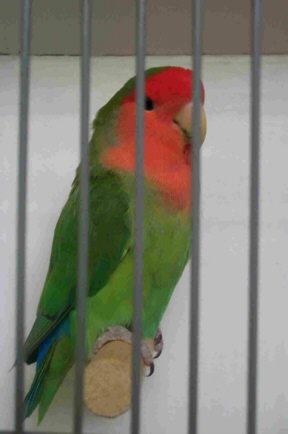
I wish to thank Marilena Salmones
for giving me permission to put the article on my webpages and Florence Richard for the
photograph.

© Didier Mervilde
2000/2001/2002/2003/2004
Permission in writing is required to link to or reproduce in any form.